
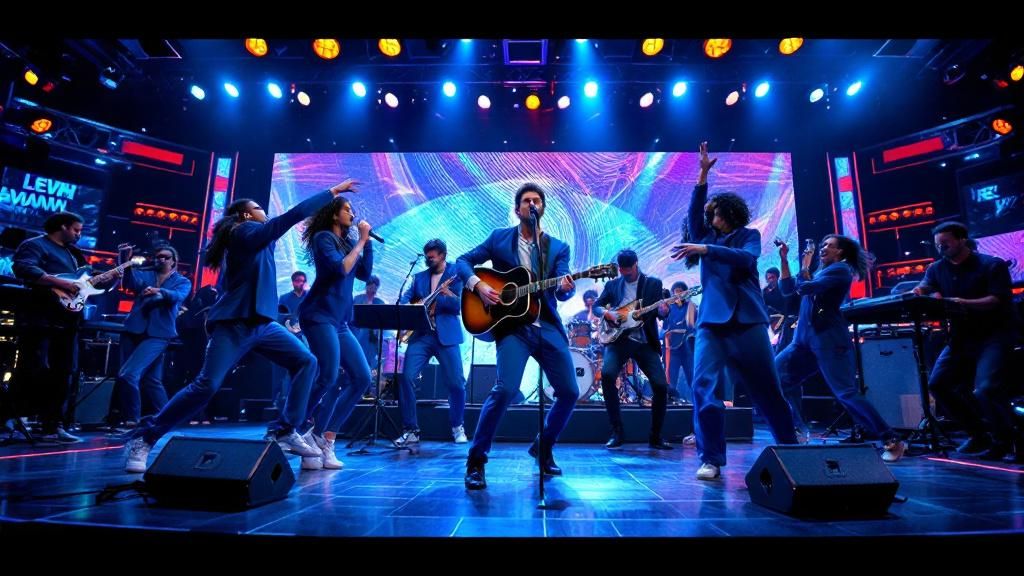
David Byrne delivered vibrant theatricality to The Late Show on 31 March, delivering a striking performance of “When We Are Singing” alongside Stephen Colbert. The Talking Heads frontman, joined by a collective of blue-dressed performers, presented the complete dance concept that has established itself as his hallmark. The track comes from his most recent release, Who Is the Sky?, issued in September 2025. During his visit, Byrne outlined his deliberate shift towards colourful, visually dynamic productions and detailed his method to combining solo work with iconic Talking Heads songs on his present tour, such as “Psycho Killer” and “Life During Wartime,” whilst upholding creative authenticity.
A Theatrical Return to Late-Night Television
Byrne’s performance on The Late Show marked a remarkable demonstration of his evolving artistic vision, one that emphasises spectacular visuals and precise choreography. The interpretation of “When We Are Singing” illustrated his willingness to tackle composition with clever self-consciousness, extracting comedy from the odd facial contortions singers invariably display during performance. When discussing his compositional choices with Colbert, Byrne revealed an almost anthropological curiosity about the mechanics of singing, observing how performers’ open mouths produce an unclear look that could suggest either ecstasy or simple physical necessity. This intellectual approach to live performance differentiates his work from conventional pop entertainment.
The aesthetic shift apparent in Byrne’s present tour showcases a intentional departure of his former grey staging approach, a intentional move rooted in contemporary cultural needs. He articulated a clear philosophy: the times demand colour and visual energy instead of severe austerity. This transition reveals Byrne’s attunement to the emotional landscape of his listeners and his acknowledgement that set design communicates meaning as powerfully as words or music. By collaborating with his blue-clad ensemble, Byrne has developed a cohesive visual language that complements his sonic investigation whilst signalling an hopeful, progressive artistic stance.
- Byrne deliberately selected “When We Are Singing” to underscore the ridiculous nature of facial expressions
- The ongoing tour showcases vibrant blue costumes replacing previous grey visual design
- The show incorporates Talking Heads classics paired with solo material from Who Is the Sky?
- ICE footage incorporated deliberately at end of “Life During Wartime” for impact
The Artistic Direction Underpinning Who Is the Sky?
David Byrne’s latest album, Who Is the Sky?, released in September, constitutes a continuation of his lifelong investigation into human conduct, perception, and creative expression. The record serves as a creative wellspring for his ongoing tour, with “When We Are Singing” demonstrating his ability to draw deep insights from daily instances. Byrne’s approach to songwriting remains distinctly intellectual, converting ordinary observations into compelling musical narratives. The album’s subject matters—how we portray ourselves, what our expressions reveal or conceal—inform every aspect of his live performances, creating a unified creative vision that goes further than conventional album marketing into something more philosophically ambitious.
The artistic fusion between the new material and Byrne’s reinvented concert visual approach creates a unified experience for viewers. Rather than approaching Who Is the Sky? as merely another body of work to be performed, Byrne integrates its conceptual framework into the performance and movement dimensions of his shows. This holistic approach reflects his decades-long commitment to breaking down divisions between music, dance, and visual art. By choosing particular pieces like “When We Are Singing” for extensive stage adaptation, Byrne demonstrates how contemporary songwriting can move beyond the studio environment and become fully realised performance art on stage.
Rethinking the Concert Atmosphere
Throughout his professional trajectory, Byrne has consistently rejected the concept of fixed, invariable concert presentations. His philosophy prioritises ongoing development and adaptation, treating each tour as an opportunity to reassess how music should be experienced in performance. The shift from subdued staging to bold, vivid visual presentation embodies this commitment to reinvention. Rather than drawing from nostalgic appeal or legacy status, Byrne deliberately develops innovative visual frameworks that enhance his present creative interests, ensuring that his shows remain contemporary and emotionally resonant rather than merely retrospective.
Byrne’s collaboration with his group of blue-clad musicians and dancers constitutes a deliberate commitment to dance narrative. By partnering with trained performers who grasp both musical and movement vocabularies, he creates multifaceted shows where dance, costume, and music communicate simultaneously. This cross-disciplinary method distinguishes his shows from traditional concert formats, framing them instead as immersive creative experiences. The combination of classic Talking Heads material alongside new material demonstrates that reimagining doesn’t require abandoning one’s past—rather, it entails placing past work within fresh creative frameworks that honour their integrity whilst investigating new possibilities.
Harmonising Tradition with Innovation
David Byrne’s approach to his catalogue reveals a sophisticated grasp of artistic responsibility. Rather than setting aside his Talking Heads era or being wholly consumed by it, he has crafted a framework that permits him to honour the past whilst preserving creative autonomy. This balance demands thoughtful selection—selecting which classic tracks deserve to be included in contemporary sets, and how they should be situated within new artistic frameworks. Byrne’s willingness to perform “Psycho Killer” and “Life During Wartime” alongside solo material exemplifies that legacy doesn’t necessarily mean stagnation or cynical nostalgia-chasing.
The challenge Byrne identifies—becoming a “legacy act that delivers the old hits”—represents a genuine artistic challenge that many seasoned artists fall into. By deliberately reducing his use of earlier material and constantly reimagining production aesthetics, he maintains creative credibility whilst acknowledging his past. This method maintains both his artistic standards and his audience’s engagement, ensuring that concerts function as vital creative expressions rather than retrospective showcases. His unwillingness to commit to a full Talking Heads reunion further underscores his dedication to artistic evolution over commercial convenience.
Talking Heads Material in Contemporary Setting
When Byrne performs “Life During Wartime” today, the song holds distinctly present-day resonance. By licensing ICE footage to accompany the track’s ending, he transforms a 1979 post-punk anthem into a reflection about present-day political realities. This curation—showing the imagery solely at the conclusion rather than from start to finish—demonstrates refined curatorial sensibility. The approach acknowledges the footage’s emotional weight whilst ensuring the performance from growing overly dark or prescriptive, upholding the song’s creative authenticity whilst deepening its present-day importance.
This contextualisation strategy goes further than simple visual support. Byrne’s commitment to weaving Talking Heads material within his active ensemble’s visual aesthetic establishes creative conversation linking historical and contemporary elements. The dressed ensemble members and vibrant staging alter the way viewers encounter these familiar songs, removing retrospective preconceptions and demanding active engagement with their present-day significance. Contrary to keeping the songs frozen in time, this strategy allows them to breathe in fresh creative settings.
- Careful inclusion of signature songs prevents creative repetition and nostalgia-driven positioning
- Updated visual framing enhances contemporary relevance while not destroying artistic authenticity
- Refusing a reunion tour allows Byrne to control the timing and manner in which Talking Heads catalogue surfaces
The Philosophy of Achievement
David Byrne’s strategy for live performance transcends simply playing songs—it embodies a carefully considered artistic framework founded upon visual story-telling and audience behaviour. During his performance on The Late Show, he articulated this perspective with distinctive care, outlining how seemingly mundane observations about human conduct inform his creative choices. His performance of “When We Are Singing” illustrates this approach: the song arose from Byrne’s observation that singers’ open mouths during singing produce an equivocal look—one that could indicate either intense euphoria or simple physiological necessity. This dry observation converts into theatrical content, showing how Byrne draws from daily life for artistic material.
This philosophical framework applies to his wider strategy to tour production and staging. Rather than approaching concerts as static presentations of studio recordings, Byrne views each tour as an opportunity for comprehensive artistic transformation. His decision to infuse the current tour with colour—a calculated contrast to the grey visual language of his earlier productions—reveals deeper beliefs about art’s role in society. In his perspective, contemporary audiences contending with uncertain times need visual energy and colour abundance. This is not simply a stylistic preference; it reflects Byrne’s conviction that performance art carries an obligation to uplift and energise, to offer sensory and emotional enrichment beyond the music alone.
Why Colour Is Important Now
Byrne’s clear declaration—”the times we live in, we need some color”—reveals how he frames creative choices within wider cultural landscapes. The shift from grey to vibrant blue-clad dancers and colourful set design underscores his conviction that aesthetic choices carry political and emotional weight. This choice recognises current concerns and doubts whilst offering an counterbalance through chromatic abundance. Rather than withdrawing towards austere monochrome, Byrne argues that art should actively resist despair through its visual language, converting the performance space into a venue of intentional, vital chromatic expression.
