
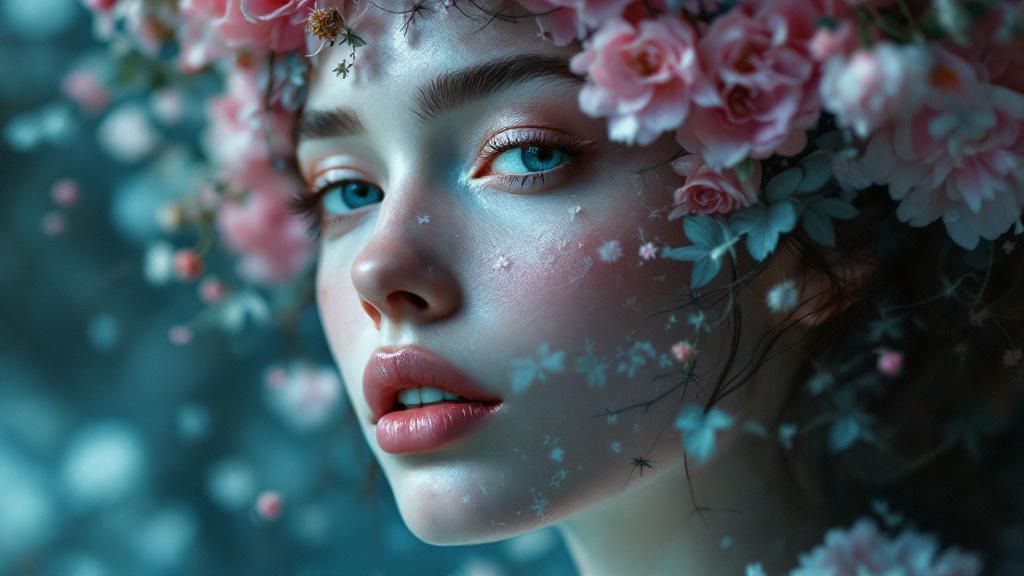
For 40 years, Dutch photographers Inez van Lamsweerde and Vinoodh Matadin have profoundly transformed the visual language of modern photographic practice. The celebrated duo have created a formidable body of work that seamlessly fuses art, fashion and portraiture, challenging the medium’s most sacred assumption: that the camera never lies. Now, a significant retrospective show and related book, Can Love Be a Photograph: 40 Years of Inez and Vinoodh, documents their extraordinary journey through carefully curated themes that illuminate the theoretical foundations of their practice. Running at Kunstmuseum Den Haag until 6 September, the exhibition demonstrates how the pair have consistently disrupted photography’s assertion of factual accuracy, reimagining their subjects through enhancement rather than disclosure.
The Dutch Masters Who Questioned Photography’s Truth
Throughout their four-decade body of work, Inez and Vinoodh have repeatedly questioned photography’s fundamental claim to authenticity. Their images stretch believability to its extreme boundaries, forcing viewers to reassess not merely what they see, but their own willingness to accept the photograph as evidence of reality. This conceptual rigour distinguishes their work from traditional portrait photography, positioning photography itself as a contested terrain where truth and artifice intersect. By treating the camera as a instrument of metamorphosis rather than documentation, they have fundamentally altered how modern image-makers engage with their subjects and how audiences consume visual information in an increasingly image-saturated world.
What sets Inez and Vinoodh distinctly is their distinctive approach to portraiture, wherein subjects are not humanised through demystification but rather enhanced through intensification. Whether documenting Brad Pitt at his most ethereal or Bill Murray with flowers interlaced with his beard, they present their subjects with remarkable tenderness, dignity and consideration. Their practice rejects the documentary impulse entirely, instead treating each portrait as an chance to reconstruct identity itself. This approach has proven remarkably consistent across decades, from their formative work in Face magazine during the 1990s to their recent explorations of cultural figures as monumental figures and deities.
- Pioneering digital manipulation techniques that challenge photographic authenticity
- Integrating classic avant-garde methods such as photomontage and collage
- Working with stylists, makeup artists and graphic designers fluidly
- Treating photographs as platforms for shared artistic intervention
Beyond Record-Keeping: Photography’s Role in Transformation
Enhancement Versus Simplification
Inez and Vinoodh’s innovative approach actively disputes the notion that photography reveals truth through exposure. Rather than stripping away layers to expose some core human truth, they utilise enhancement as their main approach. Their subjects are heightened, enlarged and reconceived through meticulous styling, imaginative light work and theoretical structures that approach portraiture as an art form rather than documentation. This approach transforms photography from a tool for uncovering into one of artistic remaking, where the self turns changeable and subject to artistic interpretation. The result is portraiture that surpasses mere likeness.
This dedication to enhancement emerges most strikingly in their treatment of cultural figures and celebrities. Brad Pitt emerges ethereal and vulnerable; Bill Murray appears contemplative with botanical elements adorning his features; Drew Barrymore is presented with an intensity that transcends conventional beauty photography. These images resist simple classification, existing instead in a undefined realm between personal identity and constructed image. The subjects remain identifiable yet fundamentally altered, reimagined through Inez and Vinoodh’s collaborative vision into something altogether more complex and visually arresting than standard celebrity photography usually produces.
At the heart of this innovative approach is the collaborative process that encompasses each shoot. Photographers, stylists, makeup artists, hairdressers, lighting technicians, graphic designers and editors come together to create unified visions that surpass any single creative perspective. Inez and Vinoodh intentionally present their photographs as blank slates—even as cadavre exquis—inviting others to intervene and contribute. This multimedia layering, accomplished via both digital manipulation and traditional techniques like photomontage and collage, creates images that are intentionally crafted, undeniably artificial and genuinely transparent about their own artificiality.
- Subjects elevated to icons, divine and phantom figures poised between reality and projection
- Styling and makeup operate as sculptural elements reshaping facial features
- Lighting design produces dimensional depth that counters photographic flatness
- Joint creative efforts weave multiple creative perspectives into singular images
- Photographs exist as disputed territories between individuality and creative expression
The Joint Canvas: Art, Fashion and Surrealism
For four decades, Inez and Vinoodh have worked at the convergence of photography, fashion, and fine art, creating a distinctive visual language that challenges conventional categorical limits. Their work deliberately blurs the lines between documentary work and constructed fantasy, approaching each photograph as a shared creative work rather than a mere recording of reality. This approach has established them as pioneers within modern visual culture, shaping successive waves of photographers, stylists, and creative directors. Their subjects—whether celebrated personalities or refined plant specimens—are elevated beyond their traditional settings into something altogether more theatrical and conceptually rich.
The studio setting encompassing Inez and Vinoodh operates as a creative ecosystem where various creative fields come together and exchange ideas. Photographers, stylists, makeup artists, hairdressers, lighting technicians and graphic designers work in concert, each contributing specialised expertise to the end result. This carefully structured collaboration reflects the surrealist technique of cadavre exquis, where artists add contributions one after another without viewing earlier work. By positioning their photographs as open canvases inviting intervention, Inez and Vinoodh democratise the artistic practice whilst maintaining a unified creative direction that unifies varied artistic viewpoints into singular, compelling images.
Digital Innovation Meets Established Methods
Whilst Inez and Vinoodh are widely celebrated for pioneering digital manipulation in photography, their practice progressively integrates established modernist methods including photomontage and collage. This conscious merger of contemporary and historical methods creates layered, multidimensional images that underscore photography’s artificial quality. Rather than trying to obscure creative manipulation, they embrace it, making the process of creation openly evident within the final artwork. This explicit multimedia approach differentiates their output from photography that maintains pretences toward objective representation.
The combination of conventional and modern digital methods demonstrates a nuanced understanding of photography’s history and current possibilities. By employing approaches linked to early 20th-century experimental artistic movements alongside advanced digital instruments, Inez and Vinoodh situate their work within larger art historical discussions. This hybrid methodology allows unprecedented control over all visual elements, from skin texture and colour intensity to layering of composition and spatial organisation. The final photographs exist as intentionally artificial constructs that seemingly convey significant insights about identity, how we represent ourselves, and the nature of photographic perception itself.
- Photomontage and collage create complex visual narratives within singular frames
- Digital manipulation extends creative authority over photographic representation
- Explicit layering acknowledges photography’s constructed and interpretive nature
- Combined approaches bridge modernist traditions and current technological potential
Love as Practice: The Most Recent Chapter
The forthcoming publication “Can Love Be a Photograph: 40 Years of Inez and Vinoodh” represents a major achievement in the Dutch duo’s illustrious career, offering a comprehensive retrospective of four decades spent challenging photography’s core principles. Rather than offering a sequential overview, the artists have curated their extensive collection through sixteen thematic frameworks that reveal unexpected links and persistent themes across their oeuvre. This thematic approach allows viewers to trace the development of their creative practice whilst acknowledging the sustained analytical depth that has characterised their practice since the 1980s. The accompanying exhibition at Kunstmuseum Den Haag offers a tangible realisation of these ideas, encouraging visitors to encounter the profound impact of their imagery directly.
Love, in the context of Inez and Vinoodh’s practice, operates not as sentimental emotion but as a intentional approach—a dedication to engaging with subjects with deep compassion, dignity and care. This philosophical stance distinguishes their portraiture from more exploitative approaches to celebrity and cultural documentation. By engaging with every subject with genuine respect and artistic sensitivity, they move beyond the superficial demands of commercial photography. Their commitment to devoting emotional and intellectual labour into every image raises portrait work to the status of fine art. The retrospective demonstrates how this foundational principle of care has maintained their artistic endeavour through technological shifts, evolving fashion cycles and shifting cultural discussions about representation and identity.
| Series Theme | Artistic Vision |
|---|---|
| Still Life | Cultural figures and botanical subjects elevated to iconic, deity-like status through monumental scale and ethereal presentation |
| Worship | Subjects reconstituted as spectral presences suspended between individual identity and collective projection |
| Post Power | Male subjects portrayed with softness and vulnerability, challenging conventional masculinity through ornamental presentation |
| New Gods | Contemporary figures transformed into contemporary deities, interrogating celebrity culture and modern mythmaking |
The exhibition and publication represent not conclusions but openings—opportunities for audiences to interact with photography’s enduring capacity to disclose, hide and reshape simultaneously. By chronicling 40 years of creative development, Inez and Vinoodh demonstrate that photography stays an extraordinarily vital medium for investigating identity, representation and the uncertain line between fact and artifice. Their output continues to inspire next-generation photographers and image makers to question received wisdom about what pictures are able to display and what they inevitably obscure. This survey guarantees their groundbreaking work will shape creative work for years ahead.
Legacy and the Future of Visual Culture
Four periods of relentless innovation have positioned Inez and Vinoodh as shapers of contemporary visual culture. Their impact reaches well past the fashion and portraiture worlds, infiltrating contemporary art spaces, exhibition strategies and critical discourse concerning how we represent itself. By methodically challenging photography’s claim to impartial documentation, they have profoundly changed how we read visual content in an era marked by digital manipulation and artificial imagery. Their legacy offers a essential lens for comprehending image literacy in the contemporary moment, where the boundaries between documentary and constructed imagery have grown progressively unclear and contested.
As rising artists traverse an unparalleled technological terrain, Inez and Vinoodh’s strategic methodology—combining traditional techniques with cutting-edge digital innovation—offers an vital blueprint. Their assertion that photography operates as metamorphosis rather than disclosure strikes a powerful chord with contemporary concerns about truthfulness and portrayal. The show indicates not an finishing point but a impetus for ongoing investigation, demonstrating that photography’s ability to interrogate, contest and reconsider remains as vital and necessary as ever. Their oeuvre ultimately confirms that visual creation possesses the power to alter societal understanding and interrogate our deepest assumptions about selfhood and authenticity.
